Thursday, 21 April 2016

The power of Personality in War by Major General Baron Von Freytag Loringhoven


BOOK REVIEW
Introduction
1.             Personalities always matters in different fields but in this book it is conveyed to readers how personalities affect in war results and how they influence their soldiers. The professional excellence no doubt plays a vital role in the war but it is always the man behind the gun who actually is held capable of utilizing it. It is always through the courageous and dedicated personality of soldiers which can alter the fate of battle field and earn honour and dignity for the nation.
2.             About the Book
a.          Title of the Book               :         The power of Personality in War
b.          Author                              :         Major General Baron Von Freytag 
Loringhovan
c.          Year of Publication           :         1955
d.          Published by                    :         Army Education Press
e.          Pages                              :         129
f.           Quality of Paper               :         Good
3.             About the Author.          Major General Baron Von Freytag is a renowned Scholar of strategic studies. The author’s dynamic personality and self experience of wars make his research and written work more practical, realistic and interesting.
4.             Summary of the Book
a.          Courage.      To live in this “element of danger and daring”, courage is the prime requisite of a warrior, According to Clauswitz, courage in the face of personal danger, is of two kinds. “First it may be an indifference to danger resulting from the nature of the individual from a disregard for life from habit. In any of these cases it may be regarded as a permanent characteristic. The second type of courage results from positive motives, such as ambition, patriotism, or inspiration. In these latter cases, courage is not a characteristic, but a feeling or an emotion.

b.          Integrity and Honour.      The character of army may at times compel a commander to forego bold operations and restrict himself to an active defence. The character of people is tested in a long defensive war just as much as in an offensive one initiative, which promotes success in tactical operations.  
c.          Self Motivation.     The influence of great military personalities appears most clearly and most strongly when some great idea motivates the actions of these great leaders. Frederick lavished on his army, he still took it for granted that the private soldier could not be imbrued with enthusiasm for a cause. He said, “All that can be done is to develop in him esprit d corps, that is, to make him believe that his regiment is the best in the world, and since his officers must sometimes lead him through the greatest of dangers, he must face his officers more than the enemy”. In the king’s mind only the officer was the depositary of the spirit of the army.
d.          Self Discipline.      Discipline acquired during peace and the power of personal example are both used to gain great sacrifices. General Kuropatkin, the Russian commander in chief in Eastern Asia, who was formerly chief of staff to Skobeleff, tells that a disciplined army knows the pulse of the battle accurately when rapid and when slow.
e.          The Degree of mastery over the troops.      The degree of mastery, which a leader has over his troops, depends upon the extent of the physical exhaustion and nervous strain to which they have been subjected. While the duties of leaders of all grades today are more difficult than they were in the Napoleonic times, the influence which an infantry officer can exercise upon a skirmish time through his personal influence and example is less immediate and more limited. The mark of the genuine hero is found on almost every battlefield hero. The general’s strength of character, his decisiveness, his steadfastness, his boldness, may even be more severely tried than in former times.
f.           Physical Endurance.       For trained soldiers of the need for bodily endurance to withstand the stress of weather, hunger, thrust and all the other hardships of war-summed up in a world of the need for that stoicism which comes, not suddenly, but gradually from military training and which, after all, is simply the ingrained spirit of honour and duty.
g.         Ideological Spirit.            The warlike spirit fades even sooner when there is no inspiring object of fight for and so help soldiers over the hardships of the moment. The body grows stronger and better able to bear hardship, but the heart and spirit become worn down, and begin to long for an end to their troubles. When unfit for further marching or for battle. Instinct of Self-preservation Produces Astonishing Feats of Endurance. Soldiers take pride in the difficulties they have overcome and dangers they have faced. 
5.             Recommendations.        The book bring to the limelight, the various desired aspects related to the personality of military men. Therefore, it is extremely useful and recommended to be studied by Young Officers. 
Conclusion
6.             To conclude few basic training and discipline matters a lot in war, personalities can turn the result of war with their influence on soldiers. Army fights a war as skilfully and successfully as is the morale and personality of soldiers. Therefore, the personality of soldiers matters a lot in war. Only the courageous and dynamic personalities possess the guts to change the fate of battle field.  

THE PIPE LINE WARFARE IN AFGHANISTAN Musa Khan Jalalzai


THE PIPE LINE WARFARE IN AFGHANISTAN
About the Author
1.         Musa Khan Jalalzai is a free lance journalist. He is an eminent scholar and has contributed a lot on terrorism, sectarian violence, foreign policy, Afghanistan, Taliban, international relations and ethnic violence. The author can speak and write Central Asian, South Asian and Middle East languages. The author is a scribe to various English Newspapers for the last fifteen years.
About the Book
2.         The pipeline War in Afghanistan is written by Musa Khan Jalalzai. The book has 166 pages. It has been published by Mobile Institute of International Affairs, Lahore. It was printed by Maktaba Jadeed Press Railway Road, Lahore in the year 2005. The first edition comprises 500 copies and costs Rs 300.
3.         This is an interesting book which gives an overview of most of the issues related to Afghanistan both internally and externally. For a casual reader, this book can prove to be a ready reckoner giving him sufficient amount of knowledge concerning Afghanistan in particular and about the neighbouring countries in general.
4.         The book has fifteen chapters, dealing with different issues; however, the focal point remains the economy. The author has talked about the role of regional powers in Afghanistan. He has highlighted the fact of Afghanistan being the world’s largest opium producer and its effects on the international world. He has also discussed Afghanistan as centre of arms sale and a home of smuggled goods.
5.         The book gives an insight of the British quest to rule Afghanistan and the wars she fought in mid nineteenth century. It also gives a background of the civil war in Afghanistan and links it to various ethnic groups in addition to the international powers which are playing a concealed game to achieve their long term strategic interests.
6.         The author has also discussed the post Soviet withdrawal period quite in detail. He has written about the pre and post Taliban era. Moreover, he has discussed about the US stance regarding the Taliban regime that used to term it as a positive development. Subsequently, he also throws some light on the US delegation that visited Afghanistan in the context of constructing a gas and oil pipeline from Turkmenistan to the Pakistan sea port of Gawadar via Afghanistan.
7.         The author maintains his unbiased style and writes amply on the terrorism camps and the training conducted in these camps. After having read this book a reader is able to draw pertinent conclusions relate to the worsening law and order situation in Pakistan. He has also commented on the questionable and flawed Pakistan’s policy towards Afghanistan. He also does not spare the UN and the USA and holds them responsible for the poor state of Afghan people.
8.         He as also discussed about Osama bin Laden, his family back ground along with the business detail and their relationship with the Saudi royal family. In the end the author has given the detail about few important letters written to the US or UN explaining the dismal situation in Afghanistan and seeking their help to undertake the remedial measures.

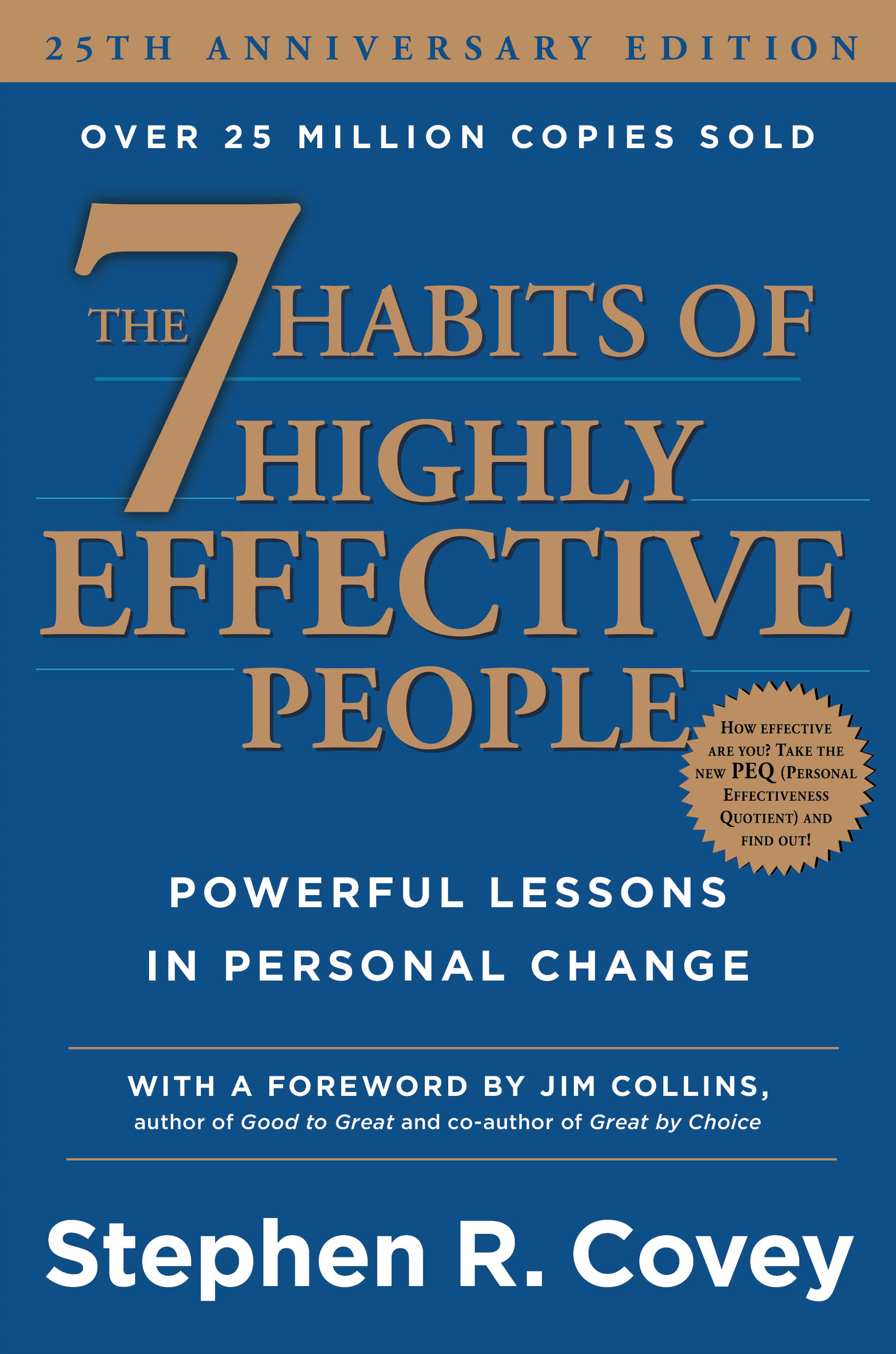
THE 7 HABITS OF HIGHLY EFFECTIVE PEOPLE By Stephen R. Covey


      BOOK REVIEW

THE 7 HABITS OF HIGHLY EFFECTIVE PEOPLE
By Stephen R. Covey, Free Press, Pages: 358
With his pioneering work in Principle Centered Leadership, Stephen R. Covey is widely acknowledged as one of the world's leading authorities on empowerment. Thousands of organizations worldwide including two thirds of the Fortune 500 have adopted his innovative techniques on quality, leadership, innovation, trust, teamwork, customer-focused service and organizational alignment.
Dr. Covey received an MBA from Harvard and a doctorate from Brigham Young University, where he was professor of organizational behavior and business management. His many awards include the Thomas More College Medallion for continued service to humanity and the Mc-Feely Award from the International Management Council for significant contributions to management and education.
Dr. Stephen R. Covey is co-founder/co-chairman of Franklin Covey Company, the largest management and leadership development organization in the world, dedicated to Dr. Covey's vision of empowering organizations to implement principle-centered leadership in their cultures.
Dr. Covey is perhaps best known as the author of The 7 Habits of Highly Effective People, which is ranked as a No. 1 best-seller by the New York Times, having sold more than 15 million copies in 32 languages and 75 countries throughout the world. He has also written a number of follow-up books, such as Power of the Seven Habits, Seven Habits of Highly Effective Families, and Beyond the Seven Habits. A sequel to The Seven Habits is The 8th Habit: From Effectiveness to Greatness published in 2004. Also, Sean Covey (Stephen's son) has written a version for teens: The Seven Habits of Highly Effective Teens. This version simplifies the 7 Habits for younger readers to better understand them. In October 2006 Sean Covey also published "The 6 Most Important Decisions You Will Ever Make, a Guide for Teens" that highlights key times in the life of a teen and gives advice on how to deal with them. His oldest son, Stephen M.R. Covey has written a book titled "The Speed of Trust."
The book begins with a personal acknowledgements page, followed by a simple and touching dedication, and then moves on to the contents. One glance at the contents page shows that the book is divided into four major parts, each dealing with a theme, building up to the next one. At the end of the main body of the book itself is a personal note by the author, followed by two appendices, and two indexes, of which one is a Problem/Opportunity index dealing specifically with some of the material presented in the book, while the other is a regular index.
The 7 Habits of Highly Effective People is one of those rare books that actually deliver what they promise, and with the maximum impact possible. Highly informative, absolutely pertinent, very positive, creatively yet simply written, with a crisp and firm tone, and given a very personalized touch, this book is a veritable guide designed to take the reader on a journey of self-exploration that culminates in the reader gaining something positive, no matter how minute, from it.
Stephen Covey builds up his book in a very interesting manner: beginning with paradigms and principles, he deals deftly with the issues of perception, conditioning, growth and change. Using terms such as proactive, reactive, synergy, the P/PC Balance (Production and Production Capability), self awareness,  EBAs (Emotional Bank Accounts),the circles of influence and concern, empathic communication, creative cooperation and balanced self-renewal, Covey charts a path for his readers that astonishes them, and at the same time, rewards them for following it. Time and again, he comes up with the importance of language, perception and the frames of reference that people use in their approach to various issues and challenges of life. Equally applicable and adaptable to individuals, families, and organizations, the framework given by Covey aims at long-term, lasting changes; changes that are there to stay.
The first part of the book deals with Paradigms and Principles, where the reader is given a few eye-openers regarding perception, the strength from within and how the seven habits given by the author can affect the reader. The second part consists of Habits 1, 2 and 3, dealing with Personal Victory: it encompasses principles of personal vision, leadership and management. The third part, Public Victory, acquaints the reader with the principles of interpersonal leadership, empathic communication, and creative cooperation. The fourth part of the book, Renewal, gives the reader some valuable principles of balanced self-renewal, aimed at the long-term practice and maintenance of the habits that Stephen R. Covey puts forth in his book. The seven habits given by Covey are             Be Proactive, Begin with the End in Mind, Put First Things First, Think Win/Win, Seek First to Understand, and Then to Be Understood, Synergize, Sharpen the Saw.
These habits move us through three different stages: Dependence, Independence and Interdependence. All these stages are interlinked, but one has to work at moving from Dependence, to being Independent, and finally achieving Interdependence. How to do so is what The 7 Habits of Highly Effective People teaches its readers. However, it is a book that has to be understood, and used in context, for it to be effective; one cannot just read it and expect wonders. It is an intricate book, certainly, but well worth the time and effort that a reader will put into it.

SEIZE THE MOMENT Richard Nixon


BOOK REVIEW

1.            Misc Info
a.         Title                            -           SEIZE THE MOMENT
b.         Author                       -           Richard Nixon
c.         Publisher                  -           Simon Schuster Publishers New York
d.         Total Pages             -           309
e.         Total Chapters        -           7

2.         Central Theme.       The book intends to address the US role in the world after historical collapse of Moscow’s satellite regimes in Eastern Europe in 1989. Since then world has changed dramatically. The US orchestrated the global coalition to liberate Kuwait in the Persian Gulf War 1990. The death of Soviet communism and the disintegration of Soviet Empire in 1991 revolutionized the global political landscape. Author emphasized that it is imperative the United States seize this moment to secure peace and advance freedom around the world.

3.         The first six chapters are about how the United States should exercise leadership in the Unipolar world. The seventh chapter is about that what Americans must do at home to have the means to lead through their actions but also to be worthy to lead through their example.

4.         Contents.      The book is divided into seven chapters giving a detailed study that what should US do after the fall of Russian empire and how should they do it  focusing  that US responsibility in the world affairs has increased and its role as a world leaders demands a lot now.

a.         Part1. This chapter deals that mission of US was not completed with the defeat of communism. This shows that wining a revolution is not easy but governing after wining is far more difficult. In this chapter Author has suggested that new American mission must be based not on the soft stand and unrealistic idealism but on the hard rock of enduring geopolitical realities as the states have Ideals and interests. Author further argued that beyond its security concerns, the United States has a profound interest in the survival of democratic states, expansion of economic prosperity through free trade and development and the promotion of democratic forms of government.

b.         Part 2.            In part 2, Author described the conditions and reasons of break up of Russian umpire. He argues that in the past conflicting values led US and Russia to look for the few areas of common interests, but now growing common values have created limitless possibilities for development of cooperative projects. In this chapter Author narrated events during the time of collapse of Russian Empire.

c.         Part 3.            In chapter3, Richard Nixon discussed the implications and effects of the Idea of “Common Transatlantic Home” given by Mikhail Gorbachev. He wrote that US should use this idea to its own interest and doors of this Common Transatlantic Home should be open to newly independent republics of Soviet Union.

d.         Part 4.            In part 4, the author has discussed the idea of shift of power to the pacific region in 21st century. Japan’s potential, its relationship with different powers and economic capabilities are discussed. Also the role of China and its potentials are discussed. Author recommended that continued US role in the pacific is indispensable.  Without US the pacific triangle will be like a three-legged stool, unstable and potentially dangerous. The competition among Japan, China and Soviet Union be unbridled, with each driven to seek preeminence in the region.

e.         Part 5.            In this chapter, Author discussed the role of Muslim World and view of common people in the west about Islam in 21st century. The author said that Muslim world is too large and too diverse to march to the beat of a single drummer. Only two common elements exist in Muslim world, the faith of Islam and problems of political turbulence. Author argued that time has come for the west to contribute to a renaissance of the Muslim world. If US engage modern states of Muslim world as full and equal partners, US can lay the foundation of such rebirth.

f.          Part 6.            In this chapter, Richard Nixon discussed the Southern Hemisphere that is  Africa, Latin America, East Asia, and South Asian region. The author argued that US should not turn its back towards this region and should help these countries to solve their problems.

g.         Part 7.            In this part, Author gave the main theme that what US should do to hold the place of world leader. He discussed that twenty-first century can be a century of peace. Because of the destruction power of nuclear weapons there will not be another world war.

5.         Comments.              The book suggests that United States must seize this moment after the fall of communism, to secure peace and to advance freedom around the world. The end of cold war has made the world more complicated. It resolved some conflicts but it gave rise to new and more difficult ones and a central US role became not superfluous but more important now than ever before.